

dabi

Type 1 Diabetes impacts every way that children go about daily life, requiring attentive care both at home and in school. There is currently a lack of products that address the rapid growth of these children and childhood milestones (such as puberty and social consciousness). We aim to reduce the stressful burden of constant management for the patient, as well as their caretakers, by addressing these gaps.
The Prompt
How can technology assist in managing home healthcare for chronic disease or elderly patients?
DURATION
FALL 2022
Aug. - Dec.
ROLE
Team Lead
Researcher
Product Designer
SKILLS
Sketching
Figma

Research.
What is Type 1 Diabetes?
Type 1 Diabetes is a condition that affects the body’s natural production of insulin, a hormone produced in the pancreas which converts sugar (glucose) from food into energy for most of the body’s cells. This lack of regular insulin results in a failure to naturally regulate blood glucose, requiring external aid to maintain healthy levels. This condition usually first presents during childhood, continuing throughout the rest of the patient’s life — this is the differentiating factor between Type 1 and Type 2, which occurs later on in life and can be somewhat prevented.
Type 1 Diabetes is a completely different lifestyle from individuals without insulin dependency, often requiring constant monitoring and substantial costs.
In 2019, of the 283,000 children and adolescents younger than 20 with diagnosed diabetes, 244,000 had type 1 diabetes.
Type 1 diabetes is one of the most common chronic diseases of childhood in the United States, accounting for over 87% of all cases in youth age 10–19 years.
Type 1 Diabetes is a lifelong disease.
How do children manage such a life-altering condition outside direct supervision of their guardian(s)?
How does puberty affect this condition?
In our research, we found...
Communication Gaps
There is a gap in communication between the student, nurse, and parent. How do we bridge that gap and take away any middle men?
Overlooked Factors
There are factors often overlooked in diabetes care: puberty, menstrual cycles, etc. How do we account for these growth factors in our product?
Anxiety
There is an immense amount of anxiety surrounding diabetes at school. How can we ease this anxiety?
Brainstorm
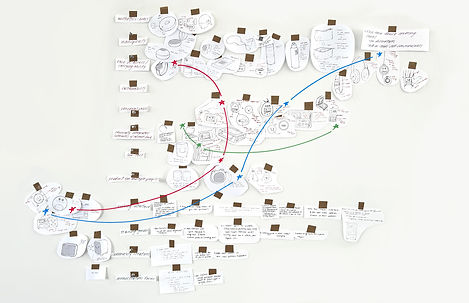
Each group member created thumbnails for products that would address separate design goals.

Decisions, decisions
In order to group the thumbnails by their shared parameters and identify which qualities we wanted to derive concepts from, we created this decision matrix.
The parameters are divided into two sections: physical and digital. The lower half of these thumbnails include digital solutions that we want to incorporate.
By connecting similar ideas and identifying parameters we wanted to include, we identified three physical and conceptual directions to follow. As mentioned previously, the lower half of these thumbnails are things we already plan on incorporating into an app.

Final Outcome.
A Systematic Approach
Rather than redesign a pre-existing monitor or insulin pump, we wanted to address gaps within the overall care system and the people involved in that system. The nurse, the parent, the patient, and communication between these parties is essential to care, and we want to make that as stress-free and efficient as possible. This ecosystem currently consists of an app, an indicator, and an emergency kit that work in tandem with existing technologies to improve care.
Care App
01.
The first part of the system is a care app for all of the stakeholders; the child (patient), the school nurse (caretaker), and the parent. In addition to the care app being the digital interface for the indicator and emergency kit, it also serves as a central location for other health tracking, like menstrual cycles, a community forum, and a multitude of resources.
The app’s functions evolve as the child and their self-administration capabilities grow. This is achieved by making certain interfaces or functions accessible at the discretion of the user or guardian.


Indicator
02.
The next product is a modular indicator that can be inserted into various attachments, such as a wristband or keychain, depending on the preference of the user. The indicator connects to an existing CGM and displays color changes and haptic alerts to notify the user of blood glucose fluctuations. This requires less constant monitoring and instead alerts the user when a problem arises.
We received feedback that this might be obsolete when Apple watches exist, but this can serve less privileged populations or just be geared towards parents who don’t want their child to have a smart watch at such a young age.


Size Reference & In Real Life
How To Use

1. Set up default/alert colors on app
2. Put on indicator (wearable pictured)
3. Receive an alert
4. Double tap to acknowledge
5. Device enters "treatment mode"
6. Receive treatment from the nurse or self administer
7. Triple tap to signify that treatment is finalized
8. Return to normal activity when indicator returns to default
Emergency Kit
03.
The final product is a reimagined emergency kit for diabetic children that would ideally be within a certain proximity of the student at all times. It uses integrated pressure sensor technology to identify which slots are filled or empty. This way, the student would have consistent access to their needed care items in the events of school emergencies such as intruder or fire drills, when they are unable to see the nurse.

How To Use
This is an example of how the kit would be used in the event of a hypoglycemic (low blood sugar) scenario.


1. Student receives a low blood sugar alert
2. Goes to nurse or self administers (ex. eating a candy from the kit)
3. Guardian and nurse receive alerts about kit usage
4. Refills are made as needed
Next Steps.
Due to the timeline of this project and feedback we received much later in the design process than we would have liked, most of our focus was placed on fleshing out the indicator and interface rather than the emergency kit. Given more time, we would like to revisit this concept and work out the intricacies much more.
The System
To reiterate, the purpose of this system is not to replace what already exists, but to expedite and increase the connections between devices and stakeholders.
